Rāda ziņas ar etiķeti world. Rādīt visas ziņas

trešdiena, 2013. gada 5. jūnijs

World Environment Day

Today is the World Environment Day, and we are going to celebrate it on green carpet too!


I was thinking of what activity would be the best for our family and our planet..
And I realized that I just simply have to address the two concepts of what UNEP has also suggested- Sustainable consumption and Food waste!

So this is what I registered at UNEP as my activity:

The change starts at the grassroots level right? So I am starting there- with myself and my family. I am discussing how food production impacts the Environment and what we can do, especially discussing food waste. Even though my mom assures we don't have much food waste since we have pets and grandmom nearby has also hens and ducks, and my mom has a worm compost "farm" too.. but still- I am on the path of finding the ways to show my family how every scrap of food can be used and how leftowers can be incorporated in further meals.. In addition I am talking with them about reducing store bought produce, reducing bread, meat and ready made items, and even reducing cooking and benefits of eating more raw food! It might not help saving hungry children in developing countries, but what we must change is the overall eating patterns of our whole planet, especially "the West".. 


Copyrights BERAS
Additional motivation for this I also found in Tallinn last week where I attended Policy forum on BaltAdapt project, and one of the participants was presenting the BERAS- Baltic Ecologycal Recycling Agriculture and Society and the concept of a Diet for a Clean Baltic:
As a consumer changing what you eat is the most important action you can take to save the environment. The following criteria can guide your choice of food weather you are an individual consumer, a professional responsible for purchases in the public sector, or running a restaurant.

First of all the food should taste good and be healthy. Organic food is good both for us and the environment. Local food and food according to season minimise transports and support our local producers. Most likely seasonal food will also cost less and give us the opportunity to stay more connected with our natural environment. Leftover food is a waste of energy and we should try to reduce it. Producing vegetables and grains is much more energy efficient than producing meat. Therefore reducing our meat consumption is the most important thing we do.

We call it Diet for a Clean Baltic.

In short, Diet for a Clean Baltic means choosing food that is produced within the natural boundaries of our ecosystem.


I'm in!!!
So- eat organic, eat local, eat seasonal, eat vegetarian and I would also like to add- eat raw!
I don't mean that you have to go 100% on any of these at once, but just start replacing step by step, introduce the good things and you'll see how the bad ones fall away real quick ;)

Let's eat food that's good for yourself, your family and your planet!


pirmdiena, 2012. gada 18. jūnijs

Rio+20 events

Online space is buzzing with events, actions, movements, discussions, conferences, blogs, news on Rio+20 topics. 13th June also held one such event here in Latvia- discussion on Rio+20 with political representatives and civil society. Thanks to homo ecos: for the event!
Some thought provoking moments, ideas and statements that were shared there:

  • Mr Edmunds Sprūdžs, the Minister of Environmental Protection and Regional Development, says that Latvia has achieved a lot already, so his speech will most probably be selling 'ourselves', showing off the progress. He believes that Latvia could try a little 'aggressive' tactics when asking others to act towards sustainable development. Mr Sprūdžs hopes to give a speech that will make others to remember Latvia after the conference. 
Well, we don't even recycle properly here. We don't have hybrid or electric cars on our roads. We have hardly few places where renewable energy like sun and wind is collected.. I don't think we can rest on what nature has given us per se like biodiversity and forests. Latvia is a beautiful, green country and we try not to spoil it. But I would not say that we have progressed that much, even though Yale says so.. 
  • Both Mr Sprūdžs and Mr Jurijs Spiridonovs who also represented political side of panel, both agreed that most important for Latvia will be meeting other leaders of states, bilateral meetings with for example Japan, and meetings with various NGOs. Connections is going to be the biggest gain from the conference rather than a document or speeches. 
I could agree that meetings, connections are going to be most important, since I'm not so optimistic on either the necessity or content of a new document or those speeches there. It's all political blaaahblahablaaah that we are expecting from there, unfortunately. What I really hope for is that governments and Mr Sprūdžs himself as well are going to take on board what Civil Society has to say, what we, people, have declared we want for our future in documents like we created last July here, and thoughts that are played in videos, statements etc. 


  • Mr Jānis Ulme from Zemes Draugi- Friends of Earth in Latvia- had more down to earth approach reminding us about the various dangers on what's going on in Rio. One of them is talking about Green Economy that has no definition or real meaning, everyone uses this label on whatever he decides with no regulation, so basically it means just blahblahblaaa again. Negotiators on the outcome document can't agree on text yet, so that shows a lot. Another risky point is the perception that we need a new document. We don't, we haven't yet managed the previous ones, we just put them somewhere aside without saying. 
I can totally relate to all what Mr Ulme said in these terms. One of my university teachers once said- we don't need to start writing a new convention, we need to start implementing the existing one and it will have immense effect (we were discussing genocide, war crime, torture topics). What happened to conventions our predecessors agreed on 1992? What about the Agenda 21? The new document should be an agreement to bind us all together to actually implement those, fill the criteria. 

  • Mr Ulme and Ms Ērika Lagzdiņa, director of Regional Environmental Centre for Eastern and Central Europe, both had some discussion on the participation of the civil society in Rio and decision making processes on sustainability issues. While Ms Lagzdiņa mentioned that original Earth Summit was a revolutionary moment when finally public voice was taken into account, Mr Ulme reminded Copenhagen and latest occasions when NGOs and acting individuals were not only left out of the process but also denied the access and their right to express themselves. 
I must admit this was one of the most scary thoughts- that our ideas, our actions would not be heard, not taken into account? I felt so sure, knowing, that there's this buzz around Rio+20, events and actions taking place during at least a month, not just those two days in June... should we feel worried that our documents are never read, videos never seen, statements not taken seriously? I hope not and I am positive that this time 'they' will hear us. 

20 Years ago 'they' agreed that Climate change is real, environmental damage, depletion and poverty is real and it is time to change our habits, our lives, time for sustainable development. Unfortunately they did let the large oil money color their glasses, they let enormous TNCs (Trans-National Companies) to lead their greedy way instead. This is the very last moment to stop it. This is the last train we must jump in to be able to                                                grant our grandchildren their future. 
I don't want to be remembered by my kids as one of those people who "could have made a difference". I don't want to be one of those who let others make wrong choices that will destroy our planet and take the chance of life away from our future generations. 
We all have to do something. And some of those things are not going to be easy. That's why we have those governments "up there"- to help us do it. We just have to ask them. Louder and probably many times. But we should ask them as many times as it takes- we want sustainable future, fair, clean and balanced lives. 


otrdiena, 2012. gada 17. aprīlis

London souvenirs....

Recently there has been some traveling on green carpet.. unexpectedly I had to pack, take my always smiling baby and go to the lovely city of London. I must admit, I was a little afraid, but it all passed- apart from smells and smokers, London is very much baby friendly city, at least people are!
Not going much into detail, but just a note about what surprised me.. When I left London for going back to Latvia with its countryside goodies, healthy environment at least while we're out of the city, and all the natural stuff available here, I never imagined I will miss.... food stores in London... Honestly.
Even though I have much better veggies, wild berries, mushrooms, dairy products form nearby farms, there are still some things I really miss. Like Rachel's organic yogurts.. Like Whole Foods stores with such a wide choice of everything.. Like Yantra, the organic, vegan cafe near the Soho Square..
The variety of organic products in everyday chain stores in Latvia is growing so slowly, while, for example, Tesco now offers I think almost everything! In terms of selling organic, our stores here are still at the level London was at least couple of years ago, but I'm staying positive about their growth towards greener products on their shelves. But for now during winter I don't really trust the veggies and fruits there, so I really enjoyed having fresh organic salad while there.
Lucky for me, we now have Baltais Eko Jogurts in various tastes and of course Daugava's production. But I still miss Rhubarb yogurt. My plan this summer when our rhubarb bush is gonna be as huge as always- make my own. I'll let you know if we succeed!
Note for others living or visiting London- enjoy your opportunities to shop and eat organic, there are many and great!

pirmdiena, 2012. gada 30. janvāris

Second greenest country in the world..

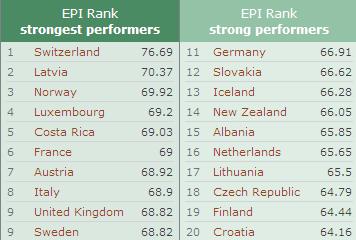
Yep, some happy news on green carpet- in 2012 Latvia has scored as second greenest country in the world according to the Environmental Performance Index (EPI) of Yale University. What can be better than being second strongest performer? Well, according to the same studies, Latvia is also the strongest improver- at the very top- No 1- in Pilot Trend EPI Rank that is based on performance over the last decade. Hooray!! But is it really?

Source: http://epi.yale.edu 

I couldn't resist to look a little more "around". I always check not only Latvia, but also neighbors- Lithuania and Estonia. Well, I thought their results were better. Lithuania is 17th in EPI Rank as a strong performer, but it's one of 'declining performers' - No 104 in Pilot Trend EPI Rank. Estonia has gone even more down than that- it's only No 54 in EPI Rank as a modest performer and down to No 128 as one of the worst decliners in Pilot Trend EPI Rank. Sad. But I cross my fingers they will increase their ranks for the next study in two years! I always check also the countries that have been my home for a while- Norway and UK. No surprise they both were in top ten in EPI Rank (No 3 Norway and No 9 UK), but I was very surprised that comparing to UK's rank as No 20 (Modest improver) in Trend Rank, Norway scored only No 84 as for 'little and no change'. This doesn't send a good message does it? You can't rest on your victories, you have to keep improving, working on all areas, even if you were No 1!

So what does EPI say about Latvia?
Even though I have some doubts about this study, I just had to peek inside the country profile of Latvia to see what's our ups and downs. Being ranked so high would be a reason to celebrate. However, that doesn't mean we are all perfect and we can rest now, even according to the EPI details. Not at all. I looked at stats (you can find them here and choosing detailed view) and found that while we are doing good in some areas, we have loads to do in others.
There are two parts of the study- Environmental Health and Ecosystem Vitality, and each has several criteria.

 Latvia has received:
      high scores in the following areas:

  • PM 2.5 under Environmental Health area 'Air (effects on human health)'. 
  • Child Mortality under Environmental Health area 'Environmental Burden of Disease', however, I believe that we could do so much better if doctors, hospitals and society would return to more natural pregnancy, child birth, nurturing and treating children. This is a whole enormous topic that could be discussed so I won't go in detail here. We need to rethink the whole concept of having and raising a baby.
  • Drinking Water under Environmental Health area 'Water (effects on human health)'. Yet again- we could do better by filtering our drinking water right in the tap, and drinking more water from springs, when possible. 
  • Pesticide Regulation  under Ecosystem Vitality area 'Agriculture'. Good, however, I'd wish we could score higher than just No 40. It 's out chance to improve it buy choosing local organic produce over chain stores and by talking to the farmers nearby our homes about health hazards of pesticides. 
  • SO2 per Capita and SO2 per GDP under  under Ecosystem Vitality area 'Air (Ecosystem Effects)'.
  • We have no results in Critical Habitat Protection, and I'm not entirely sure whether it means we don't have such habitats or that means nobody could find any information on this?
  • Marine Protected Areas under Ecosystem Vitality area 'Biodiversity and Habitat'. 
  • Biome Protection under Ecosystem Vitality area 'Biodiversity and Habitat'. Biodiversity has always been our strength and I'm happy to see us receiving highest score there.
  • CO2 per Capita and per GDP under Ecosystem Vitality area 'Climate Change'. However, we should aim to score higher, the score results are bordering on 'low' here. And comparing to other countries our ranks should be on 'low' side, so we should be more aware on our options to reduce CO2.
  • Renewable Electricity under Ecosystem Vitality area 'Climate Change'. I'm genuinely surprised about the result since Latvia is very far behind other countries in using such renewable energy as sun or wind. Besides, we've been declining performers in this area, which is a very bad trend for this era.
  • Forest Cover under Ecosystem Vitality area 'Forests'. We're No1! And this is such a lie! The problem roots back here in Latvia, where Latvijas Valsts Meži (Latvian State Forests) say that Latvia is covered with forests. But they have "lost" somewhere the definition of Forest that says that Forest is grown-up trees, not just planted trees, nor felling areas. It's completely insane. And by this definition we're the top country in forest cover. Or is it that all the other countries are in so much worse condition???
  • Growing Stock under Ecosystem Vitality area 'Forests'. No1 again. Here I could agree since we're working on renewing the forests, my family is one of many owning such business. But growing forest is a very long process and just planted fir trees are not yet a forest. 
  • Water Use under Ecosystem Vitality area 'Water Resources (Ecosystem Effects)'. We still could do much better since not many people have heard or let alone use even simple water saving devices or techniques. Let's spread the word on quick showers, buckets in wc trunks, closing taps when brushing teeth, reusable water and water savers in taps and showers! 


      low scores in the following areas:

  • Indoor air pollution under Environmental Health area 'Air (effects on human health)'. The worst part- this has been one of largest declines if we look at trend rankings. That's something we can change easily if each one of us would grow some plants in our apartments and if each one would bring a plant to the workplace. And quit those terrible conditioners that makes you cold-sick during the summer! Sometimes wearing lighter clothes, opening windows for ventilation and closing the blinds to direct sunlight is better. 
  • Sanitation- under  Environmental Health area 'Water (effects on human health)'.  I am surprised that it was one of them since we are supposed to be a developed country! Apparently it's time to look in our own backyard before defending the rights to proper sanitation of people in poor South..
  • Agricultural Subsidies under Ecosystem Vitality area 'Agriculture'. It's time to help our local farmers, support local and organic farming. It is difficult without state supporting it's people in this area. But as for ourselves as individuals- again, we can always vote with our wallets and buycott to make politicians see what we care for. 
  • CO2 per KWH under Ecosystem Vitality area 'Climate Change'. Even though comparing us to other countries we are No24 in ranking, the score is very, very low. That just means, we are there only because other countries are doing worse. But that doesn't mean we're good yet. 
  • Trawling Intensity under Ecosystem Vitality area 'Fisheries'. Again- even though we have quite high rank No 21, the score is very low. Being better than others doesn't mean we're good yet!
  • Fish Stocks Overexploited under Ecosystem Vitality area 'Fisheries'. Low both on rank and score table. Again there's a government policy needed I guess, since organic buyers will always vote with their wallets for wild fish rather than farmed ones that are fed antibiotics. 
  • Forest Loss under Ecosystem Vitality area 'Forests'. Well, that's about right finally on forests. It's been couple of years now that experts are talking about too great loss of forests here, but since it's big money, they don't have a say. The worst part is private owners who file their forests for quick money and many times don't care for renewing it. Only educating them will help. 

Associate Professor of Statistics at Yale and Principal Investigator of the 2012 EPI, John W.Emerson has said himself: "Our findings are only as solid as the underlying data, and we have a long way to go in some areas". He continues admitting that "Particularly distressing is the lack of global, accurate, and comparative data on waste management, toxic exposures, agricultural sustainability, and water resources." approving my doubts on complete genuineness of this study. But, of course, I am happy that it exists and tries to improve constantly by filling these gaps.

These results do sound both wonderful and quite unbelievable to be second greenest in the world and first in trend.. Society involvement in even such basic things as recycling, choosing organic, environmentally friendly ways of living. If that would be greater, if awareness and inspiration would increase, then we would first consider these data more reliable, and second- consciously make an effort to be the No1!
But we all have to do our share. Today I asked our maintenance guys to stop idling their car in our courtyard. And rinsed the nappies in cold wash. And did many other little things. Most importantly- read ideas that inspire, read this EPI study that made me want to do more. And tell more people to do more!

I also believe the same as Kim Samuel-Johnson, Chair of the Yale Center for Environmental Law & Policy Board of Directors and co-creator of the project that what is great is the impact of the EPI across the world, "many countries are realizing the value of using these indicators to benchmark performance over time". And I truly hope that by latest results Latvia will finally have a 'kick' to turn truly green. We live in very rich and exclusive conditions in this small country, we should stop tossing around various policy directions and use the wonderful resources we have and become a place, where people come to enjoy pure nature, import natural goods and products. 
Let's really earn the No1 rank for our country!


sestdiena, 2012. gada 7. janvāris

Garbology...

Some reading time on green carpet was filled by the Economist article on the success of our neighboring country Estonia to develop world wide movement- World Cleanup. I'm proud of the Estonians! And I'm proud to be a citizen of its neighboring country- Latvia, that also participates in World Cleanup. Every year Latvians are rushing to various places and picking up litter, cleaning the territories. Some add in  planting trees and bushes as well.
Of course, it is fantastic that such movement grows global and that those countries that are facing the real problem of trash in parts of Africa and Asia are joining in. With them on board (let's hope- not only picking up litter, but also waving flags of protest that would say "no more foreign trash") we could get a step ahead with today's garbage issues.
But is it really people of Cote d'Ivoire, India, China and Guatemala that are supposed to clean up their countries from most of the global garbage? I would say that they shouldn't have the global garbage in their territory in the first place! Maybe, when they say- Enough!- Western world will suddenly realize that it's time to change the whole idea and framework of production (read. designed to dump) to more sustainable. When West will have to deal with its own trash they've thrown away, they would finally realize, there's no such place as "away".


Of course, not all countries ship their rubbish somewhere else , but I wouldn't say that by not doing so they have found out the way how to rid themselves from illegal trash. Take Latvia for example. The Economist has said: "Estonia has a tradition of volunteer efforts aimed at cleaning up the blight of illegal rubbish dumping in public spaces (part of a legacy of environmental abuse during the Soviet occupation era)" . I suppose, we're very similar with Estonians. But if we are so concerned about illegal rubbish dumping in public spaces, why do we still need the movement to clean our country? That means- somebody is still dumping the trash, and that somebody is no one else but us. Well, maybe not me, not you, but people living among us. And even if they come out once a year to clean it up, it's not enough.
In Latvia we've had advertisements of Cūkmens (In Latvian people who trash may be called pigs, so Cūkmens=Pigman was an image of anyone littering in public) and how bad it is for the nature, how ugly it is. We have advertisements on how much waste and rubbish is thrown into our Baltic sea. On the one hand- it's fantastic that we finally talk about these problems, explain on TV, radio, internet, newspapers how damaging it is for environment, for ourselves. On the other hand- it just makes me so sad that we are in need of it.
It should come naturally to everyone that if you see a packaging paper, bottle or anything that does not belong in the forest, river, meadow, roadside etc. - you pick it up and take it to the proper place. I do that almost everyday when walking with my little one! Why can't you do it?
Some say- it's not mine. So what it is not your ice cream wrapper? It's your environment and your nature. Do you like it littered? I don't, so I pick it up. And I am not afraid to tell others to do it. And to tell them to pick up whatever they've just thrown on the ground. Maybe they'll remember next time and tell someone else too.

I do love those two new terms I learned from the Economist-

  • Garbology- is a word popularised (and possibly coined) by A.J.Weberman, a writer and activist whose credo was "you are what you throw away". / the Economist /  


  • Glocally- dealing with big global problems through myriad small or individual actions. 
These are truly inspiring and I think of acting "glocally"  as the best solution to environmental issues. Don't wait for politicians, corporations and "big guys" to act, start with yourself! 


And to finish on a positive note- I am happy for World Cleanup 2012, I'm joining in every day, I hope you will too. We might not be able to rid the planet from all the trash yet, but hey- Let's make this world clean from illegal garbage!


piektdiena, 2011. gada 9. decembris

Frustration after Durban

This morning started very well on green carpet- baby time, shower, tea, yoga, walk outside.. and then I read  The Ecologist on COP17..  feeling 'Angry' would be underestimated..
Durban was supposed to be a place where to decide more closer action and more action itself on Climate Change (CC). Unfortunately it was turned out to be a place that shows our inability to act and reach obvious goals and a place to talk about opportunities not to do anything or as little as possible.
The Ecologist also reminds that many countries are 'justifying' themselves by poor economic situation, however, what they should have done is redirection of finances from what's polluting to what's green and that would already be step ahead.
Talking about 'new deal' on CC sounds more like a "blaaablaaablaaaa".. why? As my professor Troy Gordon on Genocide, War Crimes and Human Rights class once said- we do not need new conventions now, first we have to start implementing existing ones... I say that same applies here.. Ok, Kyoto is coming to an end.. but that isn't the only document we have that is supposed to guide our statesmen how to run the country to make our world sustainable and stop CC at 2 degrees! One might argue that we need one more specific on CC and Environment. Fine, I can agree with that. But creation on such deal should not be primary now. It should be a 'side' process while we are already acting on agreed- reducing emissions (instead of trading why should I be allowed to pollute more than others), investing in renewable energy (like supporting individuals who want to put solar panels on their houses instead of subsidizing use of fossil fuels) etc. I could go on and on and on about pollution taxes that should be implemented along with incentives for those willing to use "green" technologies (cars, heating, energy etc.) or how world organisations should work out the implementation control better.
I loved what Professor Barrett offered in another article, before Durban took place. Idea on 'Carbon Club' was great, but especially good in my opinion was a Sector-by-sector approach, where countries would agree on some specific area where to apply reductions and improvements instead of this very vague goal- reduce by 40%. We could start with aviation since airplanes are super-pollutants. IMO is already doing well on shipping but we can always commit more. We could do on cars, agriculture, steel factories, textiles etc etc.. This could be applied not only thinking about CC, but also general Environmentally friendly practices. I believe this would work so much better!


Our problem here is that we agree on certain things without true wish to act on them. And why is that? Because there's no one to punish us for that. One, two, three, ten, thirty countries can sign a document stating that we are going to reduce GHG emissions, but if they don't we just keep playing shocked and say- they are bad ones.  And that's it. At the moment there are no real consequences, no sanctions, no embargoes, boycotts or such. And GHGs are flying up in the air and temperature is raising..
It makes me sad to read how slowly the reduction is going.. but it makes me truly sick to read how the EU, which is supposed to be very green and proactive, is not reducing the promised numbers but thinking of how to make the developing countries reduce the rest of the amount! Thank you, The Ecologist, for once again removing my rose colored glasses (or 'green' in this case) on the EU.
And part about climate finance?! Ughh... well, I'm not that naive to think that it's gonna be really easy to work out the huge money issues, but seeing the numbers 2 of 30 billion? That's open plan cheating. Countries are not willing to put such money in their own territory to green them up, let alone global south.. Yes, there should be more transparent and first of all- effective system to direct the money properly. The question remains- who will do that the best? And how to make sure it's not corrupted. Because- let's face it- to many people it's pure business. But I believe that it's wrong to put such people in charge. This course should be led by someone who sees the world green and sustainable in their vision, who is following idea, not money or power in their heart.
Once again it's time to realize- it's all down to us, people as both individuals and society together to act, to change and to do something. So I encourage everyone again- vote with your wallet, do some boycott and some bycott, request from your municipalities and governments what you think is right thing to do! And TALK about it with other people. And maybe, just maybe, those people up there will hear us and we will see different numbers on next meeting! Remember- you can make your voice heard, look up for chances to do that for Rio+20!


ceturtdiena, 2011. gada 31. marts

Blog badge for greener planet!

There's a new decoration on green carpet if you haven't yet noticed. A Badge. The one on the right side that says "My blog fights climate change!" And it actually does! Isn't that really 'cool'?
The whole idea is from 350.org and to be more precise- from here.
On their website they explain:
"350 is the most important number in the world—it's what scientists say is the safe upper limit for carbon dioxide in the atmosphere." so they made a promisse that for every blogger adding the Badge to the blog, they would donate the 350 ponds of carbon in bloggers name. Well, they reched their goal of 350 bloggers in under a month, so they decided to keep the 350 Challenge open indefinitely.
"Now over 3,900 bloggers are participating. To join in, post the badge to your site, let us know, and we'll offset 350 pounds of carbon in your name. That's like flicking off 100 lightbulbs for a day. Or going two full weeks without your car!" They invite you to the website.
Because when I added the Badge on green carpet, I received a thank you note, saying that:
"By displaying our badge, your blog will help us offset 122,500 lbs of CO2 -- that's like turning off 38,000 light bulbs for a day!  With your support, we're putting more clean energy on the national energy grid, and together, we can help fight global warming, one blog at a time."
So yeah- they're very cool!!!
P.S.- and I don't care that their donation will go to American renewable resources instead of where I live. We still live on the same planet, and we should take care of it together. Climate Change is not local, it's everyone's business!
If you want to add the badge- go here!

trešdiena, 2011. gada 16. marts

media disorientation

Just as I finished the last sentence of the previous thought, some new discussions happened here on green carpet. I love talks on green carpet!
This one however- frustrating. On Japan and radioactivity threats again..
First- there was some very brief informaiton presented that it's gonna be faaaaar from Chernobyl (which makes me happy). In terms of radioactivity, nuclear contamination and other issues, of course. The thing is (supposedly), that Chernobyl had everything going very very high up in the air. This is not going to happen in Japan. Supposedly it can't even seriously harm Tokyo, let alon the rest of the world. This makes me feel better.

What doesn't make me feel better is the different informaiton in media. British (BBC) say that even though it's a disaster there, the earthquaqes, tsunamis, explosions, fires- all happening. And yes, radiation levels are rising, but not to affect the whole world you know. However, Russian media (which in this case is also the source for Latvia media) makes it much more terrible, threatening. Which to believe? I have no idea, honestly.
I know, Russians tend to make things in other countries worse than they are. But maybe there is also some informaiton filtration in British media. So it's either- one of them are lying and it's not so bad there. Or- one of them is hiding information and it's much worse than we know there.
I guess all I can do now is continue to follow, compare and see what it is post factum.
Meanwhile- I feel better for the last news of it being not so bad. Of course, less terible news doesn't meen it's not devastating what happens in Japan. It still is. But I kind of feel safer with less horrible news, let' s hope they are true.

following Fukushima, diet and fear

And just as I was writing yesterday's article, the Fukushima experienced further destruction. Today the positive forecasts of the catastrophe being only local have disappeared in thin air as the contamination levels have reached 6 of 7. They call it "slow Chernobyl" as the fire is still on.

Yesterday evening as news continued there was a discussion on green carpet of how it will affect us. Seems that radiation levels in air won't reach us here in London. But it will still affect us later on. Especially what we eat..
Once the contamination is released in sea water and reaches the ocean, no more saltwater fish will be edible or other seafood either. The ones we can buy now (especially frozen) are quite safe, because it's an old catch. But later on- shouldn't.
We believe and hope that we are right, that it won't affect the fish in Baltic sea, as it's very inland, and that is a tiny bright star for not only my diet, but also for ecosystem of Baltic sea, which is already difficult enough. (Its salt level is very low compared to other seas, therefore it's  lacking the ability to cleanse itself as good as other seas).
Another "quick" effect on us personally- no picking mushrooms this year. I was already picturing the summer - me and my huge bump taking long and slow walks in the forest in the countryside and picking mushrooms, eating loads of them and preserving for winter. However unfortunately, fungus are one of the most perceptive organisms to the radiation. We'll have to resist this year unfortunately, even as far as Latvia.

As to my yesterdays question, BBC published some answers: "The authorities have pumped sea water into three reactors. This water is likely to have been contaminated by its passage through the reactor, but it is currently unclear whether any of it has been released into the environment" and that contamination "it lingers in the environment and can continue to present a problem for many years".

A lot is going to change now as the region around the reactors was very industiral, so the production of many things has been stopped and the situation will be different now for a very long time.
Experts still don't know what's going to happen today, tomorrow, and how to deal with this catastrophe and what the effects are going to be in next month, 6 months or a year. And due to contamination in the environment, there was some hint on green carpet that it will take years and years till the region will be habitable again.

As for today- I actually am scared. But my baby makes me feel positive and believe that the future holds the light as well.

otrdiena, 2011. gada 15. marts

Fukushima.. too quiet?

I was one of those kids they called a "Chernobyl kid"- I was born in February 1986 and in Latvia nobody told anyone about what happenned there or the radiation that came towards and on us. So my mum was letting me to sleep outside in the sun thinking it will be good for me.. and only later on they got the shocking news.. I really don't want my baby to be born a "Fukushima kid"..
What Japan has experienced in these last few days is tragic. Experts and IAEA say the consequences are going to be only local and nothing like Chernobyl will occur. They say it from the present circumstances though, from how it looks now. Totally calm I can be only when it is all long gone and no further explosions, leakages, earthquakes and tsunamis are taking place.
But what I am really, really shocked about is- I can't really find widely spread information on
1) further environmental effects
2) what are they doing with the sea water that goes in for plant cooling?

1- I hear that further tectonic shifts are going to take place affecting America as well, but what about the ocean, air, land pollution? Of course, saving people and cooling and watching nuclear plants now is the first and foremost important. But I believe there should be some more information on environmental issues as well.
2- The process is not very well explained in the media for people, and I wonder if they have proper water treatment and decontamination system that would? I really fear the contamination going back to the sea or land from the water that is pumped out of the pland after the cooling. Lack of information makes people more worried than they should be maybe.

Another true unexpected surprise was that one of my favourite websites theecologist.co.uk has published only one, very short article on Fukushima. And it's not even on Japan but on the discussion whether Britain should halt the plans for nuclear plant. I find it very disappointing that such a big thing as this has earned no attention.

I guess these questions will need some follow up later on.
Let's pray for Japan and Planet!